

 BTC
BTC ETH
ETH BNB
BNB XRP
XRP SOL
SOL TRX
TRX ZEC
ZEC HYPE
HYPE DOGE
DOGE XMR
XMR WBT
WBT LINK
LINK
Solana: four Coinbase spot ranges into January 2027

Does a displayed upgrade date, a testnet clock and two supply schedules justify four price ranges through January 31, 2027? Solana closed at $103.30 on Coinbase on October 17, 2026, and that session is the input, as of 17 Oct 2026, 23:59 UTC.
The plain answer is no, if the question means a direction. None of the four dates produces a price. Each date is why a single candle rule is being held out to January 31, 2027, and each range dies on a Coinbase daily close outside it.
One rule covers all four. Take the 30 complete UTC daily candles from September 18, 2026 to October 17, 2026 on one Coinbase dollar market, subtract the lowest low from the highest high, and halve the gap. Add that half to the October 17 close and subtract it. Where the coin's own print needs rounding, the ends go half-up to the same number of decimals as that close. Kraken's October 17 closes sat within a tenth of a percent of Coinbase on all four, so the calls stay with Coinbase.
Bitcoin's October 17 close is the tape
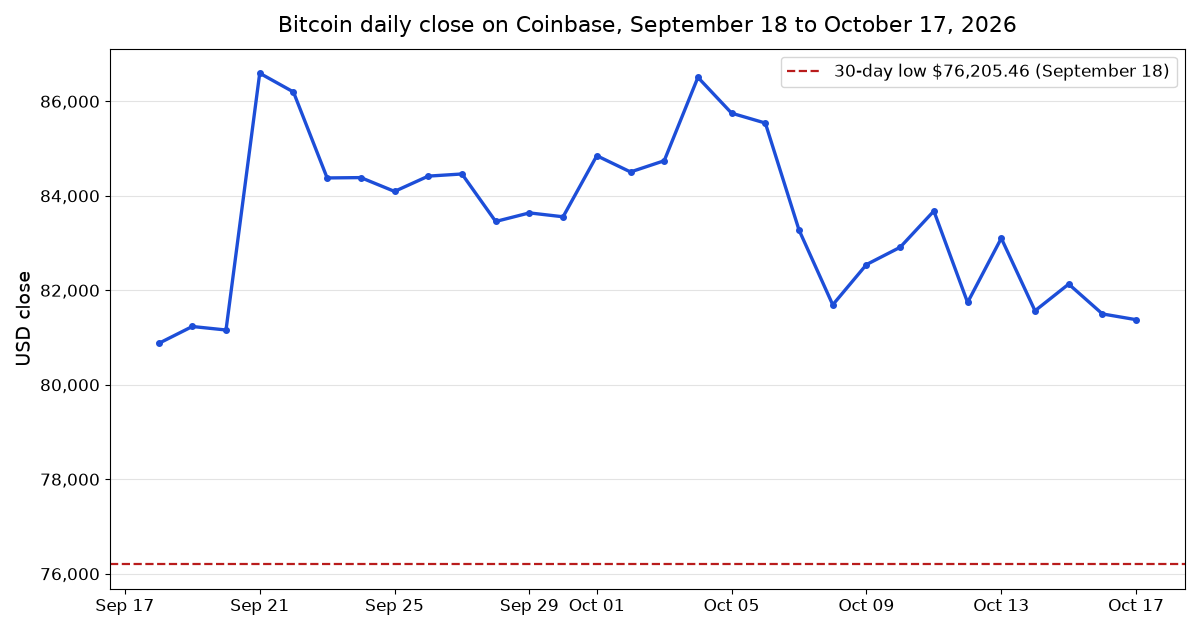
Bitcoin closed at $81,378.21 on Coinbase on October 17, 2026, as of 17 Oct 2026, 23:59 UTC, on the BTC-USD daily candles. The September 17, 2026 close on the same market was $76,348.74, so the coin rose 6.59% between those two daily closes.
Inside the window the intraday low was $76,205.46 on September 18, 2026, as of 17 Oct 2026, 23:59 UTC. The lowest close in the window ending October 17, 2026 was $80,875.04. No daily close finished under the intraday low. A shared break, set out below, uses a close under $76,205.46, the September 18, 2026 low, which would be new ground rather than a repeat of any session in the sample.
That window's high was $87,397 on September 21, 2026, as of 17 Oct 2026, 23:59 UTC. From that high to the October 17, 2026 close is a giveback, not a collapse, and it is not an input to the four ranges. The bitcoin print is context. It is a spot candle. It is not an ETF creation and not a redemption. How those baskets move coins is a different piece, How Bitcoin ETF creations work, and who holds the coins.
Stablecoin labels are not an input either. The EBA classification of USDC as a significant e-money token was filed on October 16, 2026, and it does not change these candles.
Solana's page says October 21
Solana closed at $103.30 on Coinbase on October 17, 2026, as of 17 Oct 2026, 23:59 UTC, on the SOL-USD daily candles. Kraken's SOLUSD daily close on October 17, 2026 was $103.34, four cents away, which is why the call stays with Coinbase.
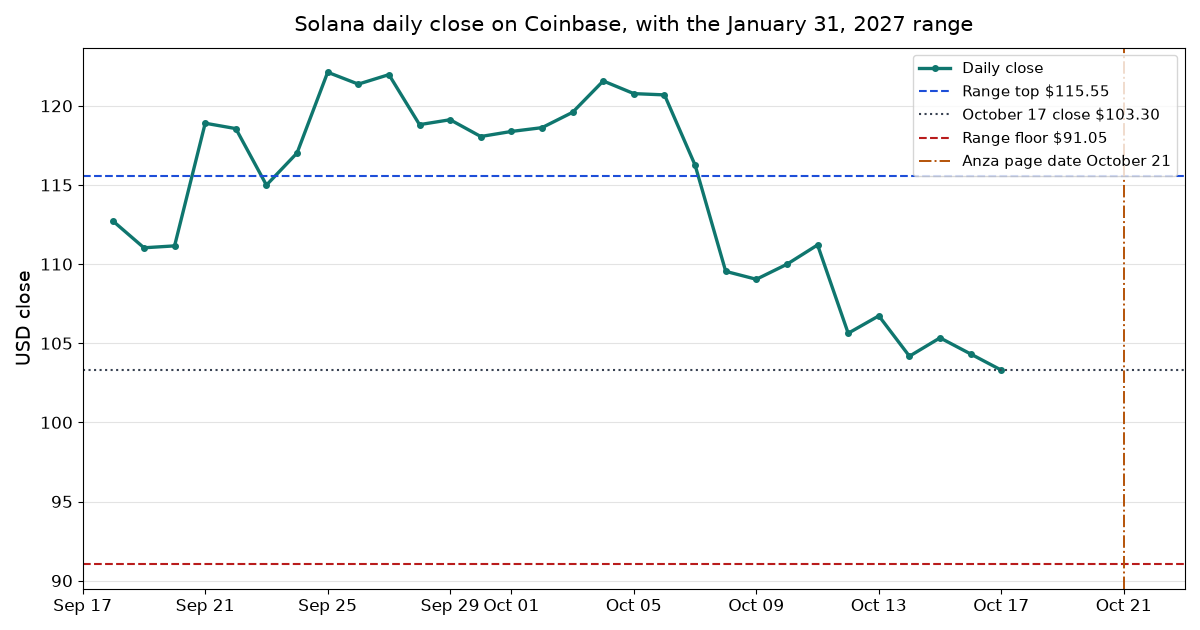
Across the same window the high was $124.93 on September 27, 2026, and the low was $100.43 on October 15, 2026. Solana fell 17.3% from that September 27 high to the October 17, 2026 Coinbase close of $103.30. Sixteen closes finished above $115.55 in the window ending October 17, 2026, as of 17 Oct 2026, 23:59 UTC.
Anza's Alpenglow page, with a page-optimised timestamp of October 13, 2026, displays Mainnet-beta as 10/21. Read against that timestamp, the date is October 21, 2026. Testnet is shown as 9/24 and devnet as 9/25, both marked completed. The page describes Alpenglow as a replacement for TowerBFT and states a finality aim of 150 milliseconds. That 150 millisecond figure is the page's aim, not a mainnet measurement.
The migration section on the same page says, "After our observation period confirms the earlier runs, migration will be announced." The feature gate that would actually switch consensus is a different artefact. On the Agave feature-gate tracker, fetched October 18, 2026, SIMD-0326 ("Alpenglow: new consensus algorithm", feature id A1pengvuM6JEcyNuTnMqepBKhwHE3N6PmUrdATGawhJS) sits under Pending Mainnet Beta Activation. The minimum Agave version listed is v4.3.0. Testnet epoch is 1042. Devnet epoch is 1167. There is no mainnet epoch in the row.
Half of the $24.50 gap between the $124.93 high and the $100.43 low on Coinbase SOL-USD daily candles from September 18, 2026 to October 17, 2026 is $12.25. Adding and subtracting that $12.25 from the October 17, 2026 close of $103.30 gives $91.05 to $115.55. The candles are as of 17 Oct 2026, 23:59 UTC.
The Solana call is a range of $91.05 to $115.55 by January 31, 2027. A Solana daily close on Coinbase below $91.05, or above $115.55, before January 31, 2027 means this call is wrong. Both lines use the October 17, 2026 candles, as of 17 Oct 2026, 23:59 UTC.
Against the call, the chart already argues. Sixteen closes in the lookback finished above the top of the range this call asks Solana to stay under, and the method does not treat that late-September path as a veto. A slip of the October 21 display would not void the range, because the arithmetic never used the epoch. The only thing that kills the call is a daily close outside $91.05 to $115.55 before January 31, 2027, as of 17 Oct 2026, 23:59 UTC.
Hoodi has a time, mainnet does not
Ether closed at $2,399.68 on Coinbase on October 17, 2026, as of 17 Oct 2026, 23:59 UTC, on the ETH-USD daily candles. The September 17, 2026 close was $2,445.44, so ether fell 1.87% between those two daily closes. The window high was $2,807.10 on September 21, 2026. The window low was $2,313.07 on October 15, 2026.
The Ethereum Foundation Protocol Cluster, on October 16, 2026, scheduled the Glamsterdam upgrade for the Hoodi testnet at epoch 132,352, slot 4,235,264, which is October 26, 2026, 17:42:48 UTC. The same post raises Hoodi's gas limit to 200 million at that epoch. Sepolia had already activated on October 6, 2026 at 13:53:36 UTC. The activation table in the post leaves mainnet as TBD.
That post states the limit in one sentence: "The mainnet activation date has not yet been decided." A comment on the October 15, 2026 All Core Devs Consensus 189 thread, from the account barnabasbusa, proposed epoch 493056 at 2026-12-01 20:38:47 UTC, with an alternative of epoch 494592 at 2026-12-08 16:29:11 UTC, and conditioned both on a successful Hoodi fork. A reply on the same thread said the December 8 alternative works for Lido because builder testing on Hoodi was still open. Those are comments on a call agenda. They are not the Foundation's activation table.
Here is the arithmetic. The ether range uses the same 30-candle window on Coinbase ETH-USD, from September 18, 2026 to October 17, 2026, where the high was $2,807.10 and the low was $2,313.07, a gap of $494.03. Half of that gap is $247.015, and the October 17, 2026 close of $2,399.68 plus and minus that half-gap, rounded half-up to the cent, is $2,152.67 to $2,646.70. The candles are as of 17 Oct 2026, 23:59 UTC.
The ether call is a range of $2,152.67 to $2,646.70 by January 31, 2027. A daily close for ether on Coinbase below $2,152.67, or above $2,646.70, before January 31, 2027 means this call is wrong. The inputs are the October 17, 2026 candles, as of 17 Oct 2026, 23:59 UTC.
Sixteen of the 30 ether closes finished above $2,646.70, from $2,775.58 on September 21, 2026 to $2,697.28 on October 6, 2026. None finished below $2,152.67. The range is therefore loose on the downside relative to the path just walked, and tight on the upside relative to where ether already traded three weeks earlier. Hoodi's gas-limit change does not alter ether supply. A testnet fork can pass cleanly and the spot price can still leave the range, which is the point of keeping the disconfirmation on the Coinbase close rather than on the epoch, as of 17 Oct 2026, 23:59 UTC.
Sui prints a step, Arbitrum's page does not
The two supply stories are not the same size, and only one of them has a current figure on the issuer's own feed. Sui's circulation API publishes a monthly series through 2030. Arbitrum's token-supply page still works its example at March 17, 2024. Treating those as equivalent "unlocks" would flatter the second and overstate the first.
Sui's November row is 20.8 million
Sui closed at $0.9755 on Coinbase on October 17, 2026, as of 17 Oct 2026, 23:59 UTC, on the SUI-USD daily candles. The September 17, 2026 close was $0.741, so Sui rose 31.65% between those two daily closes. The window high was $1.2949 on September 27, 2026. The window low was $0.7367 on September 18, 2026. One close in the window finished above $1.2546: $1.2638 on September 27, 2026. None finished below $0.6964.
The Sui Foundation's circulation API, linked from its token-schedule page, lists October 2026 circulating supply at 4,118,270,447.64 SUI, which is 41.1827% of the 10 billion cap the page states. The November 2026 row is 4,139,043,544.13. The difference is 20,773,096.49 SUI. Divided by the October figure, that step is 0.50%. The December 2026 row is 4,159,640,598.62, a further 20,597,054.49 SUI. The current-month endpoint, read on October 18, 2026, returns the October row, so November is the next line in the series, not a print that has settled. The token-schedule page calls the chart an estimate and says the release schedule revolves around how the foundation deploys its allocation.
On Coinbase SUI-USD the same window, September 18, 2026 to October 17, 2026, ran from a $1.2949 high to a $0.7367 low, a gap of $0.5582. Half of that gap is $0.2791, so the October 17, 2026 close of $0.9755 maps to $0.6964 to $1.2546. The candles are as of 17 Oct 2026, 23:59 UTC.
The Sui call is a range of $0.6964 to $1.2546 by January 31, 2027. A Sui daily close on Coinbase below $0.6964, or above $1.2546, before January 31, 2027 means this call is wrong. The candle inputs are as of 17 Oct 2026, 23:59 UTC.
This is the least informative band on the sheet. Half of a $0.5582 gap around the October 17, 2026 Coinbase close of $0.9755 swallows almost the path Sui walked, including the September 18, 2026 low, as of 17 Oct 2026, 23:59 UTC. The November step is 0.50% of the October circulating figure, and the foundation says the chart can move with deployment choices. A reader who came for a supply shock will not find one. The rally of 31.65% into the October 17, 2026 close is why the band is wide, and the market may be right that 20.8 million tokens do not reprice a coin that just did that. The call is still wrong if a daily close leaves $0.6964 to $1.2546 before January 31, 2027, and a later revision of the November row does not make it wrong.
Arbitrum is still on a monthly cadence
Arbitrum closed at $0.18102 on Coinbase on October 17, 2026, as of 17 Oct 2026, 23:59 UTC, on the ARB-USD daily candles. The September 17, 2026 close was $0.1771, a rise of 2.21% to October 17. That flat comparison hides the path. The window high was $0.25524 on September 23, 2026, and Arbitrum fell 29.1% from that high to the October 17, 2026 close of $0.18102. The window low was $0.16139 on October 8, 2026. One close finished above $0.22795: $0.23526 on September 22, 2026. None finished below $0.13410.
The Arbitrum airdrop specification says investor and team tokens have four-year lockups, first unlocking one year after the March 16, 2023 token generation event and then monthly for the remaining three years. The token-supply page dates the first unlock to March 16, 2024. Four years from March 16, 2023 runs to March 16, 2027, so November 16, 2026 and December 16, 2026 are still on that monthly pattern. The March 17, 2024 table expected 673,500,000 team and contributor tokens and 438,250,000 investor tokens in circulation, one quarter of the 2,694,000,000 and 1,753,000,000 allocations, inside a stated total of 2,653,939,384. Footnote 4 calculates those unlocked amounts as the seconds in a year divided by 12, from March 16, 2024. The page calls the circulating figure a best estimate as of March 17, 2024.
Coinbase Arbitrum daily candles from September 18, 2026 to October 17, 2026 printed a $0.25524 high and a $0.16139 low, a gap of $0.09385. Half of that gap is $0.046925, and the October 17, 2026 close of $0.18102 plus and minus that half, rounded half-up to five decimals, is $0.13410 to $0.22795. The candles are as of 17 Oct 2026, 23:59 UTC.
The Arbitrum call is a range of $0.13410 to $0.22795 by January 31, 2027. An Arbitrum daily close on Coinbase below $0.13410, or above $0.22795, before January 31, 2027 means this call is wrong. The inputs are the October 17, 2026 candles, as of 17 Oct 2026, 23:59 UTC.
This is the uncomfortable name on the list. The price is already 29.1% under the September 23, 2026 high, and the issuer's worked example of circulating supply has not been refreshed past March 17, 2024. Inventing a November token count from the seconds footnote would fake a precision the page does not offer. The wide range mostly restates a violent month, and the market may already have the remaining cadence in the price. CoinGenius has separately reported an Arbitrum governance-account phishing incident published on February 4, 2026. That episode is not this cadence.
Four ranges on one sheet
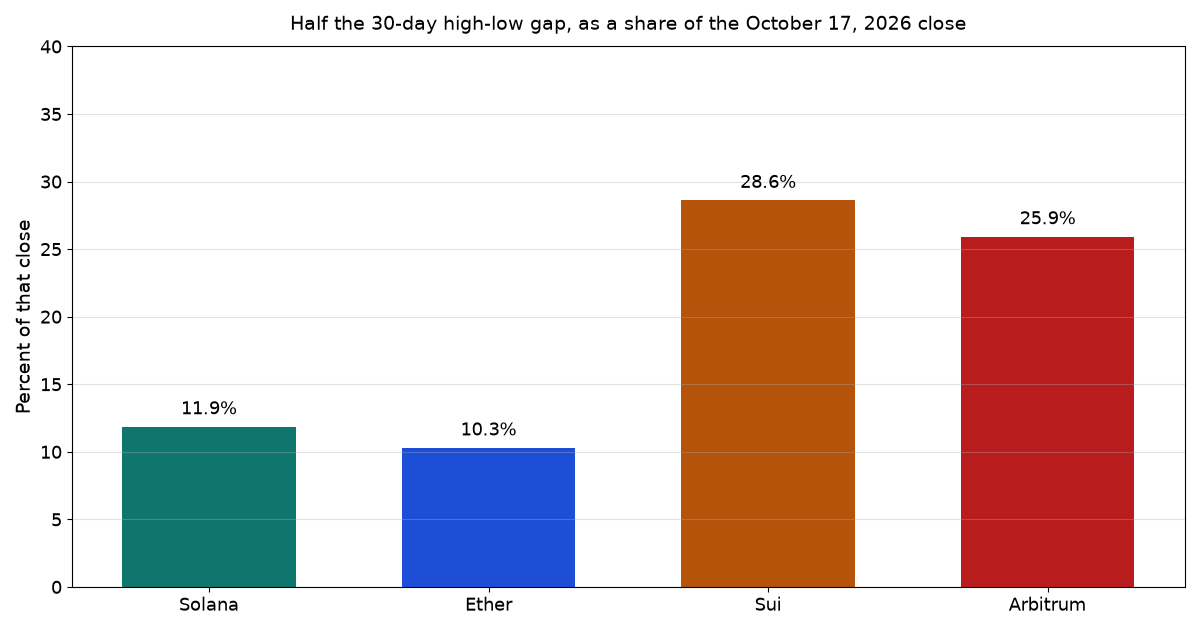
The four calls share one horizon and one rule. They do not share a width. Half the 30-day gap is 11.9% of Solana's October 17 close, 10.3% of ether's, 28.6% of Sui's and 25.9% of Arbitrum's. The percentages are the half-gaps divided by those closes, from the candles linked above.
| Asset | Close (venue, date) | Range by January 31, 2027 | Wrong if |
|---|---|---|---|
| Solana | $103.30 (Coinbase, October 17, 2026) | $91.05 to $115.55 | Daily close below $91.05 or above $115.55 |
| Ether | $2,399.68 (Coinbase, October 17, 2026) | $2,152.67 to $2,646.70 | Daily close below $2,152.67 or above $2,646.70 |
| Sui | $0.9755 (Coinbase, October 17, 2026) | $0.6964 to $1.2546 | Daily close below $0.6964 or above $1.2546 |
| Arbitrum | $0.18102 (Coinbase, October 17, 2026) | $0.13410 to $0.22795 | Daily close below $0.13410 or above $0.22795 |
Sources: Coinbase daily candles linked above, as of 17 Oct 2026, 23:59 UTC. Anza's Alpenglow page and the Agave feature-gate file, the Ethereum Foundation Hoodi post of October 16, 2026, the Sui circulation API, and the Arbitrum Foundation docs. Method: half the September 18, 2026 to October 17, 2026 high-low gap, added to and subtracted from that session's close.
A bitcoin close under $76,205.46 breaks the map
A Coinbase daily close for bitcoin below $76,205.46 before January 31, 2027 is the level at which these four ranges stop being the working map. That figure is the September 18, 2026 intraday low on BTC-USD, as of 17 Oct 2026, 23:59 UTC.
Slipping a date does not cancel the other names. SIMD-0326 can still be pending on January 31, 2027 and the Solana range is scored on the closes. Hoodi can slip past October 26, 2026 and the ether range is scored on the closes. A rewritten November row leaves the Sui range scored on the closes. Dates explain the calendar. They are not escape hatches.
Weight differs because the four coins did not share a month. Solana and ether spent much of late September above the tops now wrapped around a lower October 17, 2026 close. Sui's band is wide because the coin rallied. Arbitrum's band is wide because the coin fell. A bitcoin close through the September 18, 2026 low would mean the tape under those four paths had itself broken.
Dates from October 21 to January 31
Readers can put the dates below on a calendar. None of them, on its own, confirms or kills a range. The ranges die only on the Coinbase closes named above.
- October 17, 2026. Last complete UTC daily candles used as inputs, on Coinbase.
- October 21, 2026. Date displayed for mainnet-beta on Anza's Alpenglow page. The feature-gate file, as fetched October 18, 2026, had no mainnet epoch for SIMD-0326.
- October 26, 2026, at 17:42:48 UTC. Hoodi epoch 132,352, slot 4,235,264, in the Ethereum Foundation post of October 16, 2026. Mainnet left blank.
- November 16, 2026. Next monthly date on the Arbitrum cadence that the foundation docs start on March 16, 2024.
- November 2026. Next row in the Sui circulation series, 20,773,096.49 SUI above the October row, if the series is not revised.
- December 16, 2026. The following date on the Arbitrum monthly cadence.
- January 31, 2027. Horizon for all four ranges. A daily close outside a range on or before that date means that call is wrong.
The next date a reader can check without waiting for January is October 21, 2026, and on October 18, 2026 the Agave feature-gate file still listed SIMD-0326 under pending mainnet-beta activation, with testnet epoch 1042, devnet epoch 1167 and no mainnet epoch beside them.
This article is informational analysis only and is not financial advice. Prices are as dated in the text; crypto assets can lose all of their value.
Karthik Subramanian is a founder, writer, and technology consultant with nine years in the crypto ecosystem. He covers token economics, L1/L2 infrastructure, DeFi protocols, wallets/custody, and the bridge between crypto and forex—broker technology, liquidity, and macro drivers. Karthik’s writing focuses on clear, practical frameworks that help professionals evaluate new products and on-chain innovation alongside FX market realities.


